
1997: Sukanya Verma offers a recap of its memorable imagery.

The BSE Midcap and the Small-cap Index have run up 25.3 per cent and 31.3 per cent respectively over the past year. Valuations are no longer cheap, notes Sanjay Kumar Singh.

The NCEAR has indicated some improvement in the fourth quarter of the current financial year.

Govt keen to revive business sentiment in india.

'The farm bills will not bring in corporate zamindari'

'If we cannot conclude a trade deal, both sides are likely to take trade actions that will further impair our government-to-government ties.'

Production grew by a mere 0.5 per cent year-on-year, a significant comedown from the 3.5 per cent clocked in June.

Travis Head, D' Arcy Short and Chris Lynn have been dropped, while the pace trio of Mitchell Starc, Pat Cummins and Josh Hazlewood have been rested.

Stagnant coal production and a slowdown in power, cement and steel sectors lowered overall infrastructure growth to 5.1 per cent in May 2006 as compared to 8.1 per cent in the same month last fiscal.

Consolidation is the prime mood of the Indian equity market at the moment.
Growth in six core infrastructure industries, which have a combined weight of 26.7 per cent in the Index of Industrial Production

Ajit Mishra, vice president, Research, Religare Broking, answers your queries.
Pulled down by deceleration in crude oil production, refined petroleum products, coal and electricity, India's infrastructure industry index reported a 0.6 per cent contraction in February this year as compared to a whopping 12.2 per cent growth a ye

Analysts worry about possible loan waiver.

Apart from the growing adoption of the internet in the country, brands are drawn to the agility of the medium, its targeted and data driven approach and the increasing cost of offline channels for sales and distribution.
Infrastructure sector growth fell by 1 per cent to 5 per cent in November 2004 as compared to the year-ago period, mainly due to the slowdown in growth of petroleum refining, electricity generation and production of finished steel.
Pulled down by a poor show in crude oil and refining sectors, infrastructure growth in May 2005 slowed down to 5.6 per cent compared to 6.7 per cent in the same month a year ago.
For the April-November period of the current fiscal, the growth for the key sectors, including steel, cement, power, crude petroleum and refinery products, dropped to six per cent from 8.9 per cent

'He wrote a letter to his parents every night, and read the Gita every morning before going about his work.'

While crude oil production rose 5.8 per cent in May against a negative growth of 4.3 per cent in the same month last year, finished steel grew slightly lower at 2.5 per cent against 2.8 per cent in the same month last year, an official statement said on Monday.

Colombo seems to be veering to the middle path between China and the US on global matters, but in regional matters of strategic security, it is increasingly identifying with India, points out N Sathiya Moorthy.
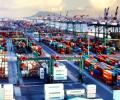
100-day agenda: Commerce ministry pushes for separate logistics department
India's core sector, which comprises six key infrastructure industries, grew 6 per cent in December, compared with 5.3 per cent growth in the previous month. The growth, signifying a recovery in industrial manufacturing, was primarily led by an increase in the production of finished steel, cement and electricity last month.

Ajit Mishra, vice president, Research, Religare Broking, answers your queries.

The GDP slumped to a three-year low lagging China for the second straight quarter -- as manufacturing slowed ahead of the GST launch amid demonetisation effect.
The core infrastructure industries, which comprises crude oil, petroleum refinery products, coal, electricity, cement and finished carbon steel - had registered negative growth for the first time in 15 years in October 2008 and then again contracted in December. The core sector accounts for 26.7 per cent of the Index of Industrial Production and the numbers signal where the economy is headed.

The broadening of the market rally sends the signal that growth will be broad-based, observes Akash Prakash.

The growth of eight core sectors slowed down to 2.6 per cent in August mainly due to contraction in steel output.

Steel and petroleum refinery products turned the table by expanding 11.7 per cent and 4.9 per cent respectively in November, 2009.

'There is no need to do anything, let your SIPs get deducted every month, and stick to your allocation between equity, fixed income and emergency funds and your risk covers.'

The financial year ending Saturday saw such big-ticket events that set the directional tone for the country's business journey.

Markets gained for the fifth straight session to end the customary 'Muhurat' trading session held to usher in the new year Samvat 2071 on a firm note post the slew of reforms announced by the government over the past few days.

'What did we get out of this agitation? Nothing... Now we feel it was all a mistake. We have no work, and our land has turned infertile. We are living in abject poverty'
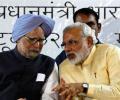
There are actually great similarities between the two PM

'Growth would have to be 7% in the October-March period, if the year as a whole is to clock 6%.' 'Who would bet on that when, in the world of real numbers, both exports and imports have continued to fall, car sales have continued to slump, and the industrial production index shows yet again a drop in output?', asks T N Ninan.
Led by poor performance in the crude oil production, key infrastructure sector continued to present a grim picture with its June growth plummeting to 4.7 per cent, thus translating into a lower growth of 4.1 per cent in the first quarter of this year

Ajit Mishra, vice president, Research, Religare Broking, answers your queries.

Factory output in June likely rose 5.4 per cent from a year earlier, faster than the 4.7 per cent growth in May, according to a poll of 27 economists.
The Aditya Birla Group company has already spent over Rs 3,000 crore on projects to take its production capacity from 17 million tonnes to 21.9 mt and plans to further scale up till 23.1 mt by June-end. K C Birla, chief financial officer, said, "We will continue to maintain our market share and, if required, we will go ahead with more capacity additions to ensure we don't become a loser in the market."

India's sourcing from China may not necessarily be for cost-effectiveness alone but also for the lack of domestic qualified bidders, technology or other know-how.
